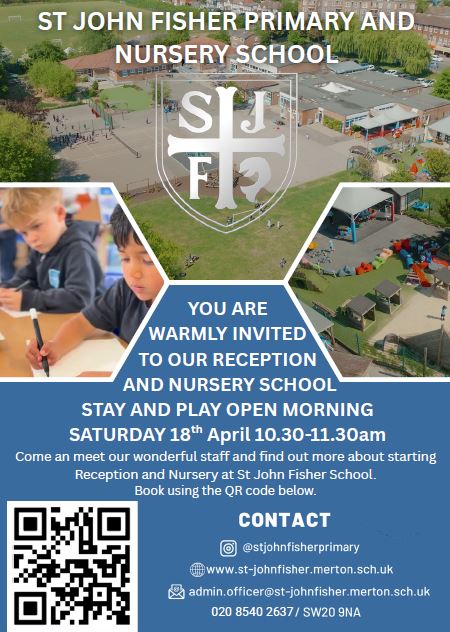
At St. John Fisher primary school we have been thinking about how playtimes are for our children. InJanuary 2026 we started to work with the not-for-profit, OPAL (Outdoor Play and Learning), to improve playtimes for all pupils. We have started to look at play as a subject in itself, planning for play in very much the same way we would look at English or maths. We have our play coordinator – Miss Cardazzone and a curricular lead for play – Miss Higgins, as well as a play team consisting of our TLA’s and lunchtime supervisors.

The OPAL ethos is that playtimes should be active, creative and involve activities that are freely chosen and directed by the child. It encourages the use of ‘loose parts’ in playtimes: open-ended materials that children can move and use in different ways, such as boxes, crates, sheets, pipes, log rounds, buckets, and blocks.
We allow children to make full use of our site — including our large field, woodland garden, St Catherine’s classroom and dedicated MUGA — in all seasons and weathers, provided they have the right footwear and clothing. This means they will need to be wearing wellies or trainers to play on the field/grass/woodland garden areas in wetter months. To ensure equal access to play, we will develop a ‘welly storage area’ for every year group.

Why is play so important?
In recent years, our pupils have lost out on lots of opportunities for play and cooperation. We have seen an increase in the number of pupils who are finding it difficult to form strong friendships, communicate their thoughts effectively and resolve conflicts when they arise. Through our OPAL play work we are beginning to notice an impact on these areas.
Incredibly, children in British primary schools spend 20% (the equivalent of 1.4 years) of their time at school in play, so it’s a really important part of the school day. Through their play, all children encounter, explore and make sense of the world and their place within it. Play can improve a child’s:
- Health and wellbeing
- Cognitive development
- Social development
- Understanding of risk and challenge
- Resilience and character.
When they are really playing, children will use their entire body and exercise every part of their mind.
The OPAL programme rationale is that “…better, more active and creative playtimes can mean happier and healthier children. And having happier, healthier, more active children usually results in a more positive attitude to learning in school, with more effective classroom lessons, less staff time spent resolving unnecessary behavioural problems, fewer playtime accidents, happier staff and a healthier attitude to life.”
Who are our OPAL working party?
Miss Kenna - Headteacher
Miss Higgins - Curricular Lead for Play
Miss Cardazzone - Play Coordinator
Miss Newman - Assistant Play Coordinator
Mr Power - Site Manager
Louisa Asgill - Governor for Play
Rachel Lim - Governor for Play
Dee Radford - Parent Play Coordinator
Ginnie McCluskie & Lisa Banning - PTFA for Play
Our lunchtimes